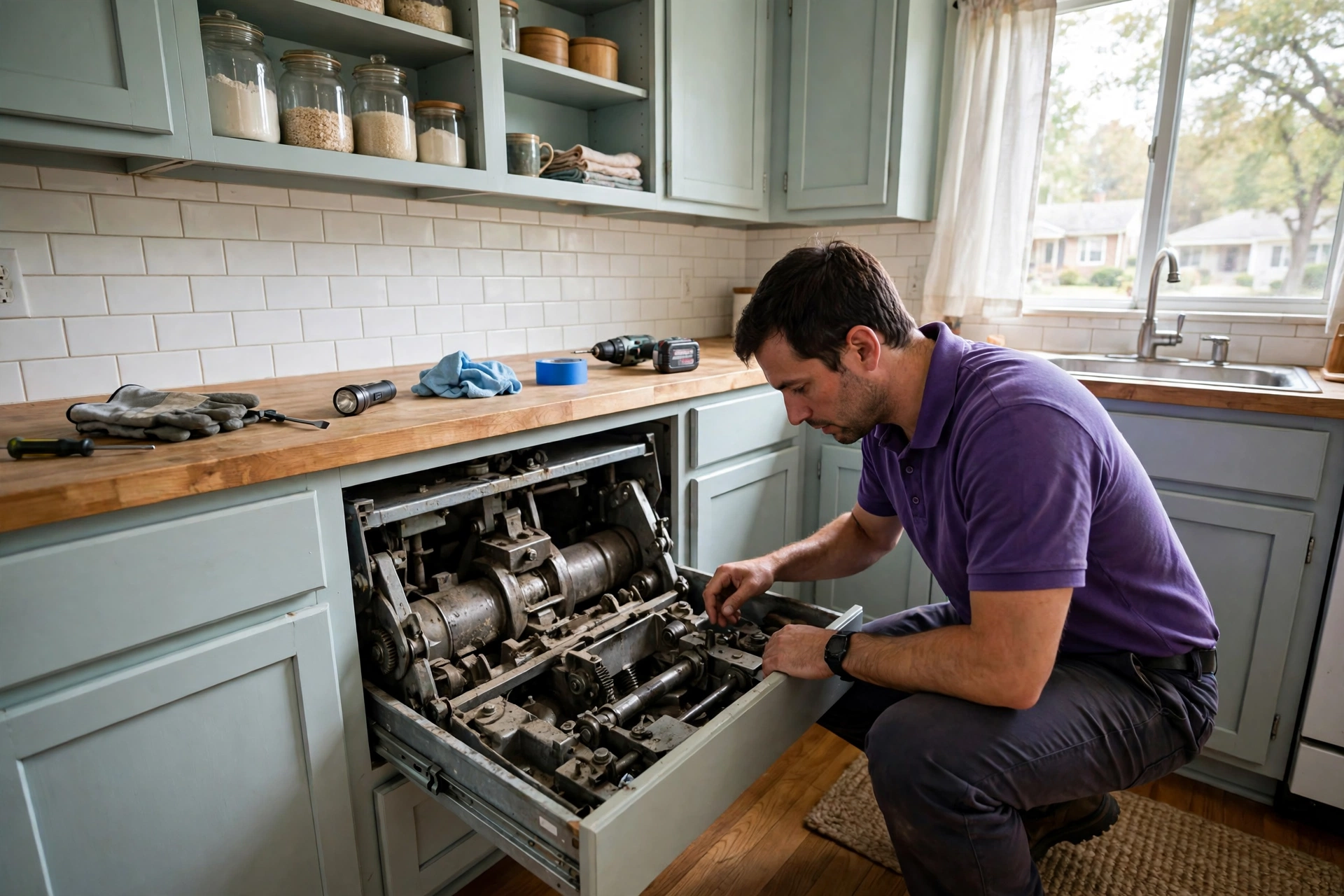
A compactor is a simple machine asked to do violent work: a ram, a drive, and a drawer that takes the abuse. We service the compactors still standing in the region's kitchens and are honest about the parts horizon on older models. In Hyattsville, the trash compactor calls follow the housing: Hyattsville mixes historic district bungalows and rowhouses near the Arts District with mid century neighborhoods toward University Park and Chillum, a housing stock whose kitchens range from carefully preserved to fully renovated.
Drive and ram faults
Compactors that run but do not crush have lost mechanical advantage somewhere in the drive, often a stretched chain slipping under load. A drawer that binds or sags changes how the ram meets its load, and correcting the drawer is part of restoring the crush. A ram that will not descend is a drive story: chain, sprockets, or the reversing switch that tells the motor which way is down.
Switches, safety, and age
Key switches and drawer safety switches guard a machine that can hurt someone; any switch fault takes the unit out of service until it is right. For discontinued models we say plainly what can be found, what can be adapted, and what no longer exists, before parts money moves.
How We Diagnose Trash Compactor Repair in Hyattsville
Compactor diagnosis runs the ram through observed cycles with the drawer loaded lightly, then inspects chain tension, switch timing, and drawer geometry in that order. Chillum and Adelphi garden apartments route turnover work through written diagnoses as standard practice.
Recent Project: Trash Compactor Repair in University Park
A call from University Park: Compactor drawer binding and sagging. Testing found flattened drawer rollers and a bent guide. We replaced the rollers, straightened the guide, and verified full travel through several cycles. Storm season flickers along the Route 1 corridor are written into control boards across whole blocks.
Trash Compactor Repair Cost in Hyattsville, MD
What moves the figure is the platform's age: current models price like any appliance, while orphan parts carry search time that is quoted openly. There are no parts ordered on a hunch: the figure follows the diagnosis, in writing, and it holds for the work described. Basement laundry in Hyattsville's older housing lives damp, and the diagnosis starts from that fact.
Why Hyattsville Calls Hyattsville Appliance Repair Co for Trash Compactor Repair
Our approach is candor plus persistence: test the machine, hunt the part with real effort, and report the odds truthfully at every step. If the repair stops making sense at any point in the diagnosis, you hear it at that point, with the numbers. That rule has cost us jobs and earned us the neighborhood, and it is not changing. The visit record stays with the Hyattsville household, readings and part numbers included.